
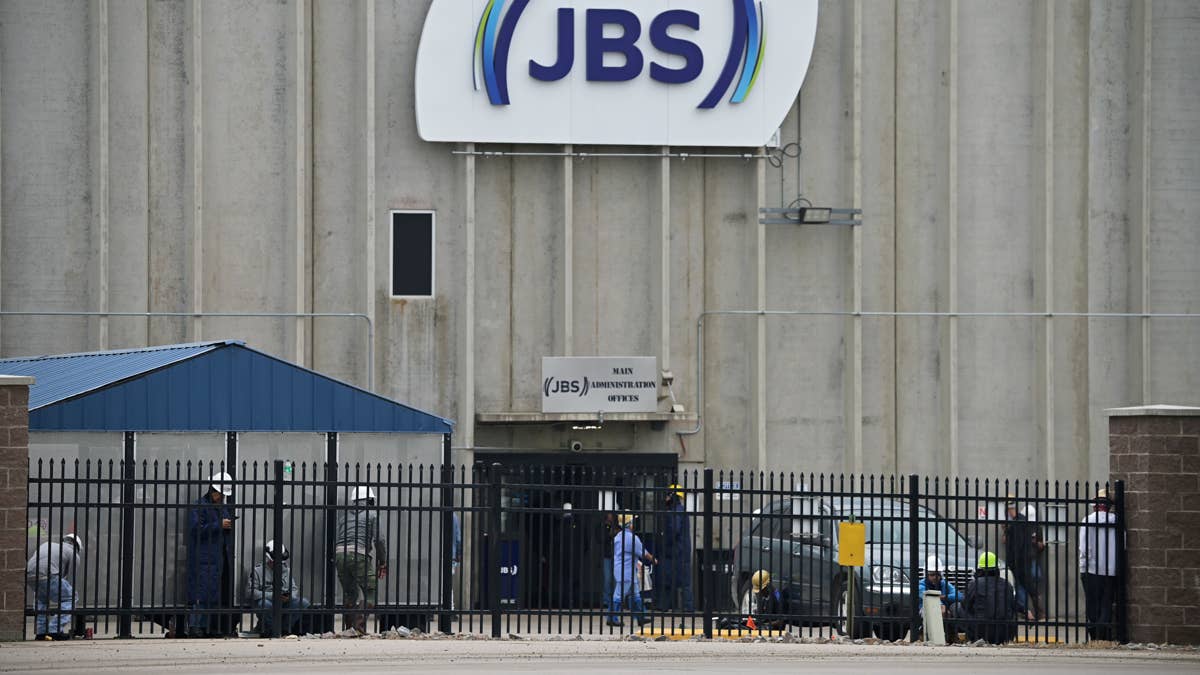
JBS is one of the biggest names behind the meat sold in grocery stores, restaurants, and food-service channels across the U.S.
The company describes itself as a leading global food company serving customers in about 100 countries across six continents.
Its portfolio includes beef, poultry, pork, and lamb, as well as prepared foods and consumer-facing brands such as Pilgrim’s, Just Bare, Swift, and 1855 Beef.
With such an expansive presence in the country, the meat giant is making a major change to its U.S. production network.
JBS USA said it plans to close two facilities, one in Pennsylvania and one in Tennessee, as part of a broader effort to strengthen operations and make its business more efficient.
The move will result in major job cuts, including nearly 1,500 workers at a single Pennsylvania facility.
The closures come at a difficult moment for the meat business as Beef prices are still climbing, and cattle supplies remain tight.
Amidst this market, food companies are trying to decide which plants are best positioned for the next stage of demand.
JBS confirms plant closures, thousands impacted
JBS USA on June 12 announced the planned closure of its beef production facility in Souderton, Pennsylvania, a suburb of Philadelphia, and a value-added facility in Memphis, Tennessee.
The company said the closures are part of targeted network changes aimed at strengthening operations going forward.
The Pennsylvania job impact is large.
A Worker Adjustment and Retraining Notification (WARN) notice filed with the Pennsylvania Department lists JBS Souderton at 249 Allentown Road and 741 Souder Road, both in Souderton, Montgomery County, to be closed.
The notice says the closure will affect 1,485 workers, effective Aug. 14, 2026.
More Layoffs:
- Breakfast giant cuts more workers after plant shutdown
- Delivery giant closes facility, cuts 100s of workers
- Uber cuts jobs while chasing major new markets
Regarding the value-added facility in Memphis, Tennessee, which is also set to close, JBS did not provide the exact number of affected employees in its announcement.
However, according to Food Dive, the Memphis facility employs about 208 people who could lose their jobs at the time of closure.
The company is set to offer impacted employees opportunities to apply for open roles at other facilities. It also promised on-site support to assist workers through the transition.
“These decisions are never easy because they directly affect our team members and the communities where we operate,” JBS USA CEO Wesley Batista Filho said in the company’s announcement.
And for the work, JBS said production from the affected facilities will be absorbed into other operations across its network. The company said that the move is intended to maintain continuity of supply and service for customers.
Batista Filho said these changes are part of a long-term plan to modernize its US operations, as it continues to invest in new facilities and improve existing ones.
“JBS USA is investing heavily in the United States and in the future of food production,” said Batista Filho. Further adding, “at the same time, we must ensure our operations are efficient, modern, and positioned to compete.
These new investments and changes are helping JBS build a “stronger and more resilient company.”
The JBS-linked changes also extend beyond the two beef facilities.
Pilgrim’s Pride, one of the largest poultry producers, owned by JBS, separately announced a $75 million investment to expand and modernize its Ellijay, Georgia, poultry facility.
Food Dive reported that as part of the expansion, some chicken production will shift from Chattanooga, Tennessee, to Ellijay.
It will lead to the partial closure of the Chattanooga plant, affecting 348 workers.
Together, JBS’s modernization and closure strategy is set to impact 2,041 workers.
JBS cuts sites while investing in others
JBS is not pulling back from U.S. food production.
Instead, the company is closing some facilities while investing heavily in others.
JBS said the latest network changes are part of a broader strategy focused on growth, modernization, and long-term competitiveness in the U.S.
The company said it has recently made major investments in Texas, Georgia, and Iowa, with a focus on prepared foods, value-added products, and more modern operations.
In February 2025, JBS announced $200 million in U.S. beef investments, including $150 million for its Cactus, Texas, beef production facility and $50 million for its Greeley, Colorado facility.
Earlier this year, JBS broke ground on the $150 million Cactus expansion.
The project includes a new fabrication floor and an expanded ground beef room. JBS said the expansion is designed to improve efficiency, increase capacity, and strengthen one of its largest and most important beef plants.
That means the company is not exiting but deciding which beef facilities fit its future.
Beef prices put more pressure on shoppers
The closures also come as beef remains one of the most expensive parts of the grocery aisle.
The USDA’s Food Price Outlook 2026 said beef and veal prices were 14.8% higher in April 2026 than they were a year earlier. The agency expects beef and veal prices to rise 12.1% in 2026.
That is well above USDA’s forecast for overall food-at-home prices, which are expected to rise 3.2% this year.
The pressure starts earlier in the supply chain.
USDA said farm-level cattle prices were 17.7% higher in April than a year earlier and are expected to rise 11.2% in 2026.
Wholesale beef prices were still 14.2% higher than a year earlier in April and are expected to rise 8% this year.
Those numbers help explain why the meat industry is under pressure even when demand remains strong.
Cattle cost more, and Beef costs more at the wholesale level. Retailers and restaurants then have to decide how much of that pressure they can absorb before customers pull back or trade down.
For shoppers, the result is simple: beef remains expensive, and cheaper proteins can look more attractive.
USDA said poultry prices were only 0.5% higher in April than a year earlier and are expected to rise just 0.5% in 2026. That price gap helps explain why chicken remains important to food companies, restaurants, and households seeking value.
USDA outlook points to a tougher meat market
The USDA’s June World Agricultural Supply and Demand Estimates report also points to continued pressure in beef.
The agency lowered its 2026 beef production forecast, saying the slow pace of steer and heifer slaughter is expected to continue through the second quarter and into the third quarter.
USDA also said cow slaughter is expected to be lower for the rest of the year.
At the same time, USDA said broiler production was raised for the rest of the year based on recent slaughter and hatchery data, as well as supportive margins.
That split matters.
Beef production is under pressure, cattle prices are high, and consumer beef prices remain elevated. Poultry, meanwhile, is seeing more stable prices and stronger production momentum.
That is the broader backdrop for JBS’s network changes. The company is closing certain facilities while investing in plants it believes can operate more efficiently and support future demand.
The federal government is also trying to expand meat-processing capacity.
USDA recently announced $60 million in funding for the Meat and Poultry Processing Expansion Program, aimed at helping eligible processors expand capacity, encourage competition, and improve supply-chain resiliency.
And the JBS closures show how much change is already underway at one of the world’s largest meat companies.
Related: 34-year-old pizza company files for bankruptcy