
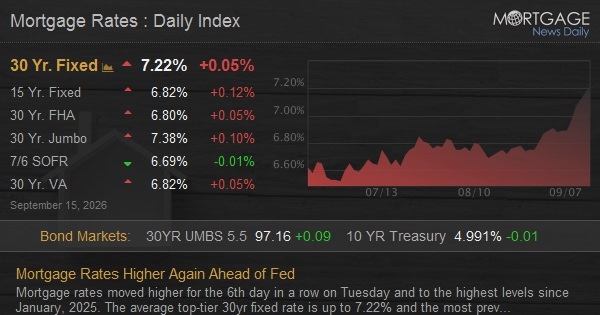
Prospective homebuyers are facing a tightening market as mortgage rates climbed for the sixth consecutive day on Tuesday, hitting their highest levels since January. The average top tier 30 year fixed rate has risen to 7.22 percent, while the most commonly quoted rate has touched 7.25 percent. This sudden surge represents an increase of 0.33 percent over less than a week, marking the most abrupt jump in borrowing costs since October of last year.
Much of this recent volatility stems from a combination of shifting economic data and fluctuating oil prices, both of which influence the Federal Reserve’s upcoming policy decisions. With a regularly scheduled announcement looming tomorrow, financial markets are heavily betting that the Fed will opt for another rate hike. However, not all economists agree that an increase is inevitable, creating a tense environment where mortgage rates could swing wildly regardless of the official outcome.
It is important to note that the Fed Funds Rate and mortgage rates operate on different parts of the financial spectrum. In recent weeks, expectations surrounding the Fed have occasionally moved in the opposite direction of longer term rates. Consequently, a decision to hike rates tomorrow does not automatically guarantee that mortgages will climb further; some analysts even suggest that a failure to hike could actually lead to worse outcomes for long term borrowing costs.
Ultimately, investors and homeowners are looking beyond a simple decision to hold or raise rates. The markets will be scrutinizing the entirety of the Federal Reserve’s communication and future projections before deciding on a definitive reaction. For now, those looking to lock in a loan are navigating an unpredictable landscape defined by anticipation and instability.